


India’s digital economy is rapidly evolving, and with that growth comes a stronger focus on data privacy and cybersecurity. In 2026, one of the biggest regulatory developments shaping the business landscape is the implementation of the Digital Personal Data Protection Act (DPDP Act). What was once seen as a future compliance requirement has now become a boardroom-level priority for startups, enterprises, fintech companies, ecommerce platforms, SaaS providers, healthcare organizations, and every business that handles customer or employee data digitally.
For many organizations, the DPDP Act represents India’s version of a GDPR-style transformation. Businesses are now expected to rethink how they collect, process, store, share, and secure personal information. The conversation is no longer limited to legal teams it now impacts cybersecurity, product design, marketing, HR, AI systems, customer experience, and even business strategy.
In 2026, compliance is not just about avoiding penalties. It is about building trust, improving security maturity, and preparing for a future where privacy becomes a competitive advantage.
Understanding the DPDP Act
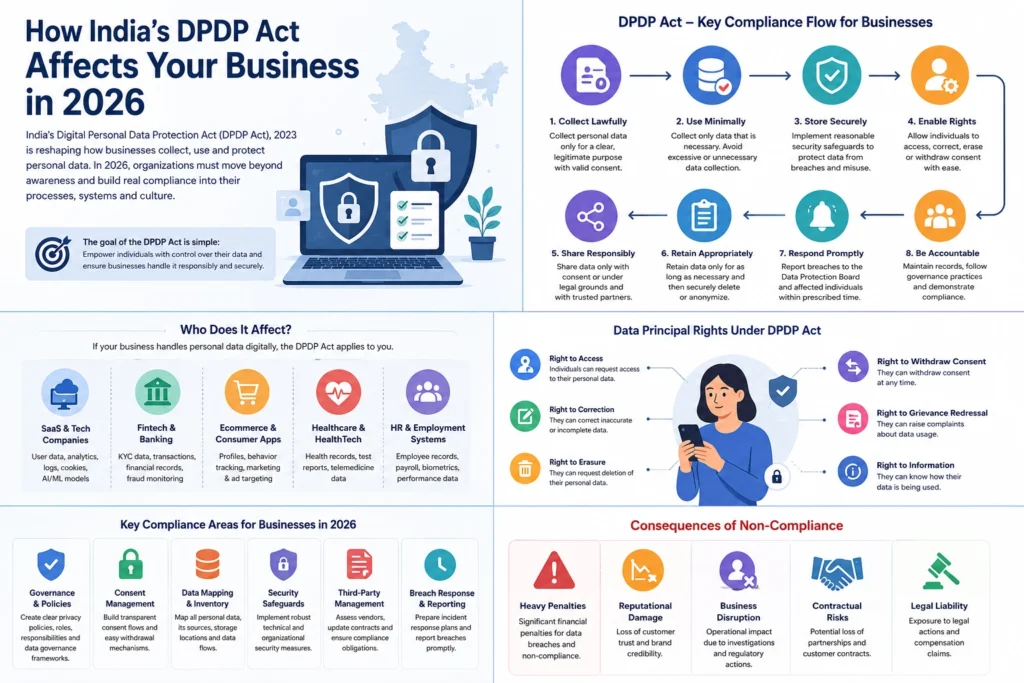
The Digital Personal Data Protection Act, 2023 is India’s first comprehensive privacy law focused on regulating the use of digital personal data. The law gives individuals greater control over how their data is used while placing clear responsibilities on organizations that process that data.
Under the Act, individuals are referred to as “Data Principals,” while organizations handling their information are called “Data Fiduciaries.” The law applies not only to companies operating inside India but also to foreign businesses offering products or services to Indian users.
At its core, the DPDP Act is built around a simple principle: organizations should collect only the data they genuinely need, use it responsibly, protect it properly, and remain transparent about how it is handled.
That sounds straightforward in theory, but for businesses, the operational impact is significant.
Why 2026 Is a Turning Point
Although the law was passed earlier, 2026 is the year when businesses are expected to actively operationalize compliance frameworks. Regulatory guidance, implementation rules, and enforcement expectations are becoming clearer, and organizations can no longer delay preparation.
Many Indian companies historically treated privacy as a secondary compliance issue. Data collection practices were often broad, privacy notices were vague, and consent mechanisms were designed more for convenience than transparency. The DPDP framework changes that entirely.
Businesses are now expected to know exactly what personal data they collect, why they collect it, where it is stored, who has access to it, and how long it is retained. Companies that cannot answer these questions clearly may face both regulatory and operational risks.
For startups and fast-growing digital businesses, this transition can be particularly challenging because many systems were built for growth speed rather than privacy governance.
Consent Is No Longer a Formality
One of the biggest shifts introduced by the DPDP Act is the importance of meaningful user consent.
In the past, businesses often relied on lengthy privacy policies filled with legal language that users rarely read. Consent checkboxes were bundled into onboarding flows, and many organizations collected more information than they actually required.
Under the new framework, consent must be clear, informed, specific, and easy to withdraw. Users should understand what data is being collected and why.
This directly impacts:
- Mobile applications
- Ecommerce platforms
- SaaS onboarding systems
- Marketing automation tools
- Customer analytics platforms
- AI-powered recommendation systems
For example, a fintech app collecting location data for fraud prevention must clearly explain why that information is needed. An ecommerce company using customer browsing behavior for targeted advertising must ensure users are informed properly.
This shift forces businesses to rethink user experience design itself. Privacy is now becoming part of product architecture.
Data Minimization Will Change How Companies Operate
The DPDP Act pushes organizations toward “data minimization,” meaning businesses should collect only the information necessary for a legitimate purpose.
This is a major cultural change for many companies.
For years, businesses stored massive amounts of customer data because it might become useful later for analytics, personalization, AI training, or marketing campaigns. However, under the DPDP framework, excessive or unnecessary data collection can become a liability.
In practical terms, organizations may need to redesign forms, reduce unnecessary data fields, remove outdated records, and establish stronger retention policies.
For example, if a service platform only requires a phone number and email to operate, collecting additional demographic information without justification could create compliance concerns.
This also increases pressure on internal data governance teams. Businesses must now maintain visibility into where data exists across cloud systems, databases, CRMs, employee devices, and third-party vendors.
Cybersecurity Is Now Directly Linked to Compliance
The DPDP Act is not only about privacy it also raises the importance of cybersecurity.
Organizations handling personal data are expected to implement “reasonable security safeguards” to prevent breaches and unauthorized access. This means businesses can no longer treat cybersecurity as an isolated IT function.
Weak security practices may now lead to both regulatory scrutiny and reputational damage.
In 2026, companies are increasingly investing in:
- Security monitoring
- Threat detection platforms
- Identity and access management
- Data encryption
- Endpoint security
- Security awareness training
- Breach response frameworks
- Third-party risk management
The reason is simple: if customer data is compromised, regulators may examine whether the organization had adequate safeguards in place.
For businesses already facing rising ransomware attacks, phishing campaigns, insider threats, and cloud misconfigurations, the DPDP Act adds another layer of urgency.
Privacy compliance and cybersecurity maturity are now deeply interconnected.
AI Companies Face New Challenges
Artificial intelligence and machine learning companies are among the sectors most affected by the DPDP framework.
AI systems rely heavily on data for training, optimization, personalization, and predictive analytics. However, the law introduces important questions around lawful data processing, consent, transparency, and accountability.
Businesses building AI products may now need to evaluate:
- Whether training data contains personal information
- If users provided valid consent
- How long data should be retained
- Whether automated decision-making affects user rights
- How to explain AI-driven outcomes transparently
This is especially important for AI-driven fintech, recruitment, surveillance, healthcare, and behavioral analytics platforms.
As AI adoption accelerates across India, companies will increasingly need privacy-by-design architectures instead of retroactive compliance fixes.
Vendor Risk Is Becoming a Major Issue
Many businesses rely on external vendors for cloud hosting, analytics, payment processing, HR systems, CRM platforms, and customer engagement tools.
Under the DPDP framework, organizations remain responsible for how personal data is handled even when third parties process that data on their behalf.
This means businesses must now carefully evaluate vendors from both a cybersecurity and privacy perspective.
Questions companies are asking in 2026 include:
- Where is vendor data stored?
- What security controls exist?
- How quickly can breaches be reported?
- Does the vendor support user deletion requests?
- Are international data transfers protected?
- What happens after contract termination?
Vendor risk management is no longer just procurement paperwork it is becoming a critical compliance function.
Data Breaches Can Become More Expensive
The financial and reputational consequences of data breaches are expected to rise significantly under the DPDP ecosystem.
Apart from direct business disruption, companies may face:
- Regulatory penalties
- Customer lawsuits
- Loss of user trust
- Brand damage
- Investor concerns
- Contractual liabilities
For digital-first companies, trust is often their biggest asset. A serious breach can damage customer confidence far more than traditional operational failures.
As a result, incident response preparedness is becoming a major focus area in 2026. Businesses are creating dedicated response playbooks, conducting tabletop exercises, and improving breach detection timelines.
Organizations are realizing that preventing breaches is important, but responding effectively is equally critical.
Startups Are Not Exempt
A common misconception is that privacy laws only affect large enterprises.
In reality, startups may face even greater operational challenges because they often scale rapidly without mature governance frameworks. Many startups rely heavily on third-party APIs, cloud platforms, growth analytics, and aggressive user acquisition strategies.
The DPDP Act forces startups to think about privacy much earlier in their lifecycle.
Investors are also paying closer attention to compliance readiness. Companies handling sensitive data without proper governance may face due diligence concerns during funding rounds or acquisitions.
In 2026, privacy readiness is increasingly becoming part of startup credibility.
Compliance Can Become a Competitive Advantage
While many businesses initially view the DPDP Act as a regulatory burden, forward-looking organizations are treating it as an opportunity.
Customers are becoming more privacy-conscious. Enterprises increasingly prefer vendors with strong security practices. International partnerships often require mature data governance frameworks.
Companies that invest early in privacy engineering, cybersecurity, transparency, and governance may gain long-term advantages in customer trust and market positioning.
In many cases, strong compliance practices also improve operational discipline. Businesses gain better visibility into their systems, reduce redundant data storage, improve internal security, and strengthen resilience against cyber threats.
Privacy is gradually shifting from a compliance checkbox to a business differentiator.
The Road Ahead
India’s DPDP Act marks a major transformation in how businesses handle personal data. In 2026, organizations are entering a critical transition phase where privacy and cybersecurity can no longer remain secondary priorities.
Businesses that delay adaptation may struggle with operational disruptions, compliance pressure, and reputational risks later. On the other hand, organizations that proactively invest in governance, cybersecurity, privacy engineering, and responsible data practices will be better positioned for long-term growth.
The future of India’s digital economy will not be defined only by innovation speed it will also be defined by trust.
And in the years ahead, trust will belong to businesses that protect data responsibly.