


The global data economy no longer runs only on technology. It runs on trust, compliance, accountability, and regulation. For Indian companies serving international clients, handling customer analytics, running SaaS platforms, processing HR records, managing fintech operations, or operating global capability centers, data privacy has become a strategic business function rather than a legal afterthought.
Two major frameworks are now shaping how Indian businesses process personal information: India’s Digital Personal Data Protection Act (DPDP Act) and the European Union’s General Data Protection Regulation (GDPR). While both laws aim to protect individual privacy and regulate how organizations collect and use personal data, they are built on different philosophies and operational models.
For many Indian organizations, especially those serving clients in Europe while operating in India, understanding the gap between DPDP and GDPR is critical. GDPR compliance alone does not automatically guarantee DPDP compliance, and vice versa.
The challenge is no longer simply about avoiding penalties. It is about building a governance model that works across jurisdictions, satisfies international clients, reduces regulatory exposure, and strengthens customer confidence.
The Rise of Privacy Regulation in India
India’s DPDP Act, passed in 2023, marked the country’s first comprehensive digital privacy legislation. The law applies to digital personal data processed within India and also applies extraterritorially when organizations offer goods or services to individuals in India.
The law emerged at a time when India’s digital economy was expanding rapidly through fintech platforms, AI-driven services, e-commerce ecosystems, health-tech applications, and social media growth. Increasing cyber incidents, concerns around unauthorized data usage, and global pressure for stronger privacy safeguards accelerated the need for a structured data protection framework.
Meanwhile, GDPR has already established itself as the global benchmark for privacy governance since becoming enforceable in 2018. It influences how multinational corporations design their data systems worldwide and has inspired privacy legislation across several countries.
Although the DPDP Act draws inspiration from GDPR, India intentionally chose a more flexible and business-oriented structure rather than directly replicating the European model.
Understanding the Core Philosophy Behind Both Laws
GDPR was designed around the concept of individual autonomy and fundamental privacy rights. The framework is detailed, highly prescriptive, and deeply rights-centric. It provides individuals with extensive control over their personal information and imposes significant accountability obligations on organizations.
The DPDP Act takes a comparatively pragmatic approach. It focuses primarily on digital personal data and seeks to balance privacy rights with economic growth, administrative efficiency, and innovation. Rather than creating a highly complex compliance architecture immediately, India introduced a broader framework that can evolve over time through rules and enforcement practices.
This philosophical difference explains why GDPR often appears more rigid and operationally demanding, while DPDP appears more flexible but still evolving.
Scope of Data Covered
One of the most important differences lies in the type of data covered under each regulation.
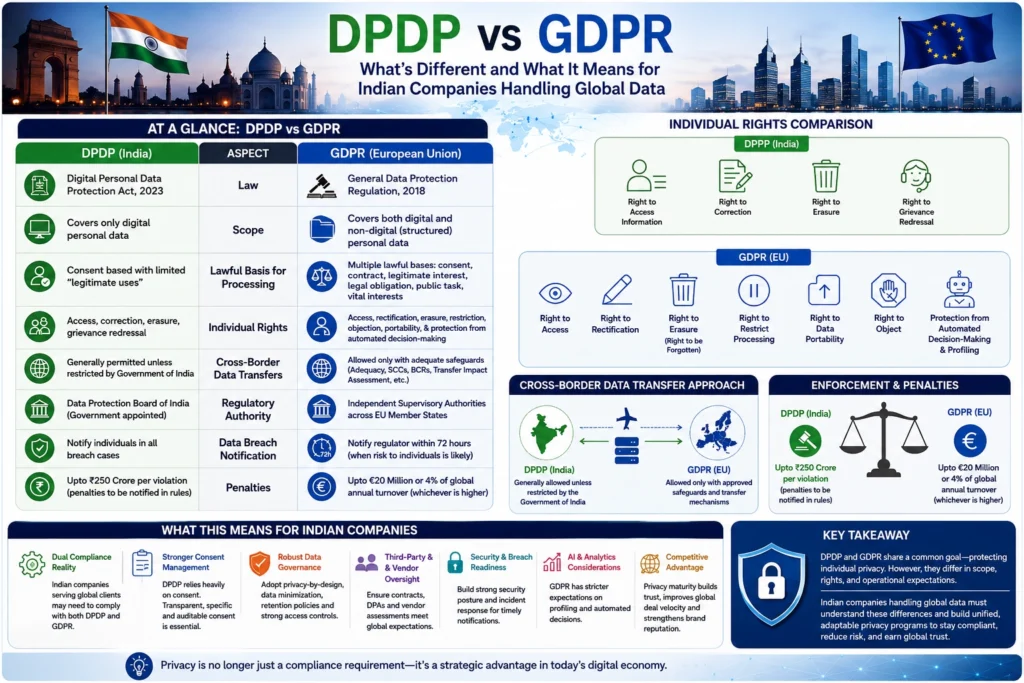
GDPR applies to both digital and structured non-digital personal data. If information can identify an individual and is stored in a structured filing system, GDPR may apply to it.
The DPDP Act is narrower in scope. It applies only to digital personal data, including offline information that has been digitized. Purely offline records generally fall outside its scope.
For Indian companies, this distinction matters significantly in sectors like healthcare, logistics, insurance, manufacturing, and education where physical documentation may still exist. A company processing European customer records in physical archives may still fall under GDPR obligations even if those records are not digitized.
Consent and Lawful Processing
Consent is central to both frameworks, but GDPR provides a much broader range of lawful processing bases.
Under GDPR, organizations may process data using several legal grounds including consent, contractual necessity, legal obligation, legitimate interest, public task, and vital interests. This gives businesses operational flexibility when managing enterprise-scale processing activities.
The DPDP Act relies far more heavily on consent, supplemented by a smaller category called “legitimate uses.” These include circumstances such as state functions, medical emergencies, employment-related purposes, and compliance obligations.
For Indian businesses, this means consent management becomes extremely important under DPDP. Organizations cannot casually assume implied permission or rely broadly on legitimate interest arguments in the same way many GDPR-regulated entities do.
This has operational implications for marketing platforms, analytics systems, AI models, user profiling, targeted advertising, and employee monitoring systems.
User Rights Under GDPR Are Much Broader
GDPR grants individuals an extensive set of enforceable rights. These include the right to access data, rectify inaccuracies, erase data, restrict processing, object to processing, request data portability, and avoid automated decision-making.
The DPDP Act includes rights to access information, correction, grievance redressal, and erasure. However, several GDPR rights do not yet exist in equivalent form under India’s framework. Rights such as data portability, restriction of processing, objection to profiling, and automated decision safeguards are either absent or significantly narrower.
This difference becomes particularly important for Indian SaaS companies, AI firms, HR-tech providers, and fintech businesses serving European clients. Even if their domestic compliance aligns with DPDP, they may still need additional governance mechanisms to satisfy GDPR requirements.
Cross-Border Data Transfer Rules
Cross-border data movement is one of the most critical operational concerns for Indian companies handling international data.
GDPR allows international transfers only under approved safeguards such as adequacy decisions, Standard Contractual Clauses (SCCs), Binding Corporate Rules (BCRs), and transfer impact assessments.
India’s DPDP Act takes a comparatively open approach. Cross-border transfers are generally permitted unless the Indian government specifically restricts transfers to certain jurisdictions.
This creates an interesting dynamic. Indian companies serving EU customers must still satisfy GDPR transfer requirements even though DPDP itself may not impose equivalent restrictions.
For example, an Indian software company storing European customer data on Indian servers may still require SCCs and detailed transfer safeguards under GDPR regardless of DPDP flexibility.
Regulatory Structure and Enforcement
GDPR enforcement operates through independent supervisory authorities across EU member states coordinated through the European Data Protection Board.
The DPDP Act establishes the Data Protection Board of India, with members appointed by the government. Some experts have raised concerns regarding institutional independence and the breadth of exemptions available to state agencies.
Enforcement maturity also differs significantly. GDPR has years of legal precedents, enforcement actions, and judicial interpretation behind it. DPDP remains comparatively new and will likely evolve substantially through future rules, notifications, and enforcement decisions.
For businesses, this means GDPR compliance expectations are currently more predictable, while DPDP implementation practices may continue to develop over the coming years.
Data Breach Notification Requirements
Both laws require organizations to report data breaches, but the operational requirements differ slightly.
GDPR generally requires breach notification to regulators within 72 hours when the breach poses risks to individuals’ rights and freedoms.
Under the DPDP framework, organizations are expected to notify affected individuals in all breach cases, which may create broader communication obligations for Indian businesses.
This becomes especially important for companies handling large-scale consumer data because incident response plans must now include legal coordination, technical forensics, customer communication workflows, and regulatory reporting processes.
What This Means for Indian Companies Operating Globally
For Indian companies, the practical reality is straightforward: dual compliance is becoming the norm.
A Bengaluru-based SaaS company serving European clients may simultaneously fall under GDPR for its EU customers and DPDP for Indian users. A fintech platform processing payment data across regions may need to maintain separate data governance workflows for different jurisdictions. A multinational GCC operating from India may face overlapping obligations from European regulators, Indian authorities, and client-specific contractual requirements.
Recent reports suggest many Indian Global Capability Centres are still in early compliance stages despite active implementation timelines under India’s privacy regime.
This reflects a broader challenge across the industry. Many organizations initially approached privacy compliance as a documentation exercise rather than a structural transformation initiative.
Modern compliance now requires organizations to rethink several operational areas simultaneously:
- Data collection practices must become purpose-specific and minimal.
- Consent systems need to be transparent and auditable.
- Third-party vendor management requires tighter scrutiny.
- Employee training becomes essential because privacy risks often originate from operational mistakes rather than technical failures.
- Incident response mechanisms need faster escalation and reporting capabilities.
- Data retention policies must become more disciplined and automated.
- AI systems must increasingly incorporate privacy-by-design principles.
The Growing Impact on AI and Analytics
One area where the difference between GDPR and DPDP becomes especially visible is artificial intelligence.
GDPR contains detailed principles around automated decision-making and profiling. The DPDP Act currently lacks equivalent operational depth in AI governance.
For Indian AI startups and analytics firms serving global markets, this creates a strategic challenge. They may comply domestically while still facing European scrutiny over algorithmic transparency, explainability, and profiling risks.
As AI adoption accelerates across recruitment, healthcare, finance, cybersecurity, and marketing, privacy compliance will increasingly intersect with AI governance frameworks.
Indian businesses that proactively align with global AI privacy expectations may gain a competitive advantage in international markets.
Why GDPR-Level Privacy Standards Are Becoming a Competitive Advantage
Many Indian companies still view GDPR compliance as a burden imposed by international clients. In reality, stronger privacy governance is increasingly becoming a business differentiator.
Global enterprises now evaluate vendors not only on pricing and technical capability but also on privacy maturity, security posture, audit readiness, and governance frameworks.
Organizations with strong compliance programs often experience:
- Higher enterprise trust
- Faster international deal closures
- Reduced legal exposure
- Improved cyber resilience
- Stronger customer confidence
- Better investor perception
- Greater readiness for future regulation
As India’s digital economy expands further, privacy maturity may soon become as important as cybersecurity certifications or cloud capabilities in enterprise procurement decisions.
The Future of Privacy Compliance in India
India’s DPDP ecosystem is still evolving. The introduction of operational rules and enforcement activity during 2025 and 2026 signals that regulatory expectations are becoming more concrete.
Over time, India may gradually move closer toward international standards as global trade, cross-border digital services, and AI regulation continue to evolve.
For Indian businesses, the smartest approach is not to build separate fragmented compliance programs for each jurisdiction. Instead, organizations should create a unified privacy governance model capable of adapting across multiple regulatory environments.
Companies that treat privacy as a long-term governance capability rather than a temporary legal requirement will likely emerge stronger in the global digital economy.
Conclusion
The DPDP Act and GDPR share a common objective: protecting individuals in an increasingly data-driven world. However, they differ substantially in scope, enforcement maturity, legal structure, user rights, and operational expectations.
GDPR remains broader, stricter, and more rights-focused. India’s DPDP Act is comparatively flexible, digital-first, and still evolving through implementation.
For Indian companies handling global data, the message is clear. GDPR compliance alone is not enough, and DPDP readiness cannot be ignored. Organizations operating internationally must understand where the two frameworks overlap, where they diverge, and how to design governance systems that satisfy both.
The companies that adapt early will not only reduce regulatory risk but also position themselves as trusted global digital businesses in an economy where data responsibility increasingly defines market credibility.