


For most startups and small-to-mid-sized businesses, cybersecurity leadership feels like a luxury. Hiring a full-time Chief Information Security Officer (CISO) can cost more than an entire engineering team in the early stages. Yet the threats facing SMEs today are no longer “small business problems.” Ransomware gangs, phishing campaigns, insider risks, compliance obligations, and cloud misconfigurations target organizations of every size.
That’s why the Virtual CISO (vCISO) model has become increasingly popular among startups and growing businesses. A vCISO provides executive-level cybersecurity leadership on a fractional or outsourced basis, helping companies build mature security programs without the cost of a full-time executive.
But what does a vCISO actually do every week?
Many business owners imagine cybersecurity leadership as someone reviewing firewall logs all day or responding to breaches. In reality, the role is far broader. A vCISO sits between technology, business strategy, compliance, risk management, vendor oversight, employee awareness, and executive decision-making.
For startups and SMEs, the vCISO often becomes the translator between technical security teams and business leadership. They help founders understand cyber risk in business language, prioritize spending, prepare for audits, and ensure the organization doesn’t grow faster than its security posture.
This blog breaks down a realistic week in the life of a vCISO working with SMEs and startups.
Monday: Risk Reviews and Executive Alignment
Mondays usually begin with leadership discussions.
A vCISO often starts the week reviewing the organization’s current risk landscape. This includes examining unresolved vulnerabilities, recent incidents, new compliance requirements, vendor risks, and upcoming business initiatives that could introduce security exposure.
For startups, this might mean reviewing the security implications of launching a new SaaS feature. For SMEs, it could involve evaluating third-party vendor access or preparing for a customer security questionnaire.
The most important part of Monday is aligning cybersecurity priorities with business goals.
A strong vCISO does not operate like a disconnected technical consultant. They work closely with founders, CTOs, operations heads, and sometimes even investors to answer questions like:
- What are the company’s biggest operational risks?
- Which systems are business-critical?
- What would happen if customer data were compromised?
- Which compliance requirements are becoming urgent?
- Where should limited security budgets be invested first?
Modern cybersecurity frameworks such as the National Institute of Standards and Technology Cybersecurity Framework emphasize governance, risk management, and business alignment as foundational security functions.
A vCISO helps leadership move away from reactive security decisions toward structured risk management.
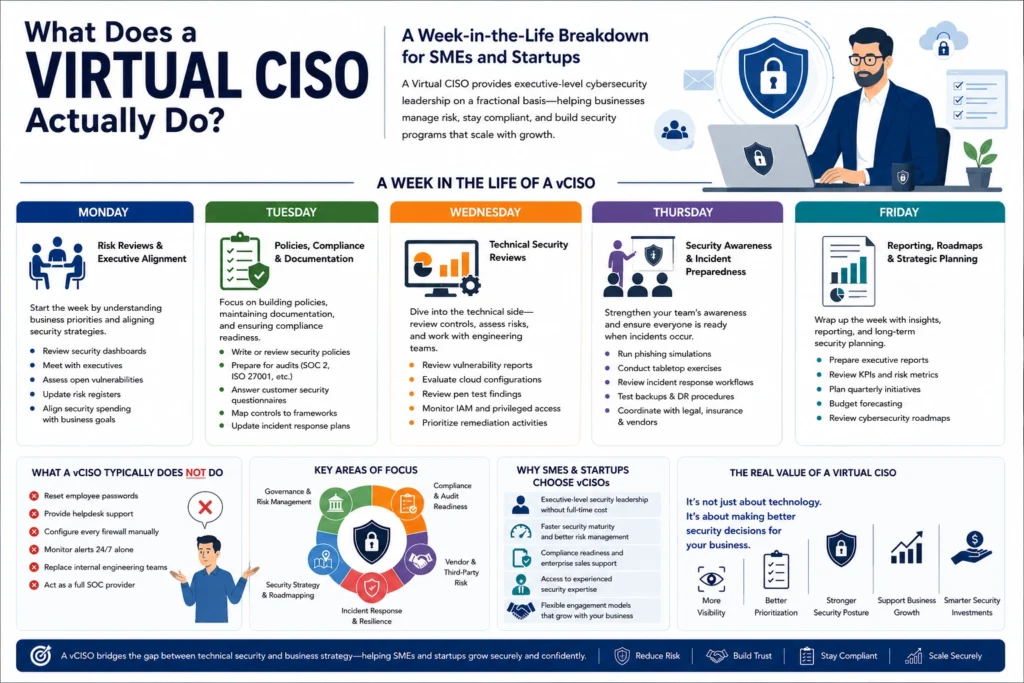
Typical Monday Tasks
- Reviewing weekly security dashboards
- Meeting with founders or executives
- Assessing open vulnerabilities
- Prioritizing remediation efforts
- Reviewing customer compliance requests
- Updating risk registers
- Aligning security spending with business goals
For many SMEs, this leadership layer is the biggest missing piece. They may already have IT administrators or DevOps engineers, but they lack strategic cybersecurity oversight.
That gap is exactly where a vCISO operates.
Tuesday: Security Policies, Compliance, and Documentation
Tuesday is often documentation-heavy.
While “documentation” may sound boring, it is one of the most important aspects of cybersecurity maturity. Many startups fail enterprise sales opportunities because they cannot demonstrate formal security governance.
A vCISO helps create and maintain policies such as:
- Access control policies
- Incident response plans
- Password standards
- Vendor security procedures
- Data retention policies
- Backup and disaster recovery guidelines
- Employee acceptable-use policies
For SMEs pursuing compliance certifications like ISO 27001, SOC 2, HIPAA, PCI DSS, or India’s DPDP-related governance practices, documentation becomes critical.
The vCISO ensures these policies are not just copied templates sitting unused in folders. They tailor them to actual business operations.
This is also the day many vCISOs spend working on audit readiness.
Startups increasingly face security reviews from enterprise clients before deals are approved. Procurement teams may send lengthy questionnaires asking about encryption, access controls, cloud security, incident response, and employee awareness training.
A vCISO helps answer these questionnaires accurately while ensuring the company genuinely meets its claims.
Typical Tuesday Tasks
- Writing or reviewing security policies
- Preparing for SOC 2 or ISO 27001 audits
- Reviewing customer security questionnaires
- Mapping controls against compliance frameworks
- Updating incident response documentation
- Reviewing data protection obligations
- Conducting gap assessments
This compliance-oriented work is one reason vCISOs are valuable for fast-growing SaaS startups. Enterprise buyers increasingly expect mature security governance before signing contracts.
Wednesday: Technical Security Reviews
Wednesday is where strategy meets technical reality.
Although a vCISO is not always performing hands-on engineering work, they must deeply understand technical security controls.
A large portion of the day may involve reviewing:
- Cloud security configurations
- Endpoint protection coverage
- Identity and access management
- Vulnerability scans
- SIEM alerts
- Security monitoring reports
- Backup validation
- Multi-factor authentication deployment
- Third-party integrations
For cloud-native startups, misconfigured AWS, Azure, or Google Cloud environments are among the most common risks.
The vCISO collaborates with DevOps teams, IT administrators, and external security vendors to ensure foundational controls are properly implemented.
This often includes prioritization.
SMEs rarely have unlimited budgets or personnel. A vCISO helps determine which vulnerabilities actually matter most to the business instead of overwhelming teams with hundreds of low-priority alerts.
The role is as much about reducing noise as it is about improving security.
Frameworks like the National Institute of Standards and Technology Cybersecurity Framework emphasize identifying, protecting, detecting, responding, and recovering from cybersecurity risks through structured controls and governance.
A vCISO turns these frameworks into practical actions.
Typical Wednesday Tasks
- Reviewing vulnerability assessment reports
- Meeting with DevOps or engineering teams
- Evaluating cloud configurations
- Reviewing penetration test findings
- Assessing vendor security tools
- Prioritizing remediation activities
- Monitoring privileged account access
This technical oversight prevents cybersecurity from becoming disconnected from actual operational systems.
Thursday: Security Awareness and Incident Preparedness
People remain one of the largest cybersecurity risks.
Phishing, credential theft, weak passwords, and accidental data exposure still cause major incidents across organizations of all sizes.
That’s why Thursdays are often focused on awareness and preparedness.
A vCISO may conduct employee training sessions, phishing simulations, or tabletop exercises designed to test how teams respond during cyber incidents.
For startups, incident preparedness is often overlooked until something goes wrong.
A vCISO changes that by ensuring everyone knows:
- Who responds during a breach
- How incidents are escalated
- Which systems are prioritized
- How customers are informed
- When regulators must be notified
- How evidence is preserved
- What business continuity procedures exist
This becomes especially important for companies handling customer data, payment information, healthcare records, or sensitive intellectual property.
Many vCISOs also coordinate with legal teams, insurers, and external incident response providers.
Typical Thursday Tasks
- Running phishing awareness campaigns
- Conducting tabletop exercises
- Reviewing incident response workflows
- Updating business continuity plans
- Coordinating cyber insurance requirements
- Testing backup recovery procedures
- Training employees on security practices
Preparedness is one of the clearest differences between mature organizations and reactive ones.
A startup without incident response planning may lose weeks during a breach. One guided by a vCISO can often contain incidents far faster.
Friday: Reporting, Roadmaps, and Strategic Planning
Fridays are usually dedicated to reporting and long-term planning.
A vCISO translates technical cybersecurity activities into executive-level business insights.
Instead of presenting raw technical jargon, they explain:
- Current organizational risk levels
- Security program maturity
- Budget priorities
- Compliance progress
- Vendor risks
- Incident trends
- Strategic recommendations
This communication layer is essential because founders and executives typically do not want dozens of vulnerability scan screenshots. They want clear answers:
- Are we secure enough for enterprise customers?
- What are our biggest risks?
- Where should we invest next quarter?
- Are we compliant?
- Could a cyber incident disrupt operations?
A vCISO builds security roadmaps that balance protection, growth, and operational practicality.
For SMEs, this roadmap often includes gradual maturity improvements instead of expensive enterprise-grade transformations.
Typical Friday Tasks
- Preparing executive security reports
- Reviewing KPI and risk metrics
- Planning quarterly security initiatives
- Budget forecasting
- Vendor evaluations
- Board or investor briefings
- Reviewing cybersecurity roadmaps
This strategic oversight helps organizations mature steadily rather than reacting only after incidents occur.
What a vCISO Does Not Usually Do
One common misconception is that a vCISO replaces the entire IT or security team.
In reality, they usually focus on leadership, governance, risk, and strategic oversight rather than daily operational support.
A vCISO typically does not:
- Reset employee passwords
- Provide helpdesk support
- Configure every firewall manually
- Monitor alerts 24/7 alone
- Replace internal engineering teams
- Act as a full SOC provider
Instead, they guide internal teams and external vendors while ensuring security decisions align with business objectives.
Why SMEs and Startups Are Choosing vCISOs
The traditional full-time CISO model often does not fit smaller organizations.
According to industry discussions around the evolution of the CISO role, virtual and fractional CISOs have become increasingly popular among SMEs because they provide executive security leadership without the cost of a permanent senior executive hire.
For startups, a vCISO offers:
- Strategic security leadership
- Compliance readiness
- Investor confidence
- Enterprise sales support
- Faster security maturity
- Reduced breach risk
- Access to experienced expertise
- Flexible engagement models
For SMEs, the benefit is often operational clarity.
Instead of reacting to random security issues, they gain structured governance, risk prioritization, and long-term planning.
The Real Value of a Virtual CISO
The biggest value of a vCISO is not technology.
It is decision-making.
Most cybersecurity failures in SMEs are not caused by a lack of tools. They happen because organizations lack visibility, prioritization, governance, and preparedness.
A good vCISO helps businesses understand where their real risks exist, which investments matter most, and how to build security programs that scale alongside growth.
They bridge the gap between technical security controls and business strategy.
For startups preparing to scale and SMEs navigating increasing regulatory pressure, that leadership layer can become one of the most important business investments they make.